Fiction Friday (the second)

Heart beats. Faster. Faster. Faster. It feels like a racing, fluttering, thing trying to escape from her chest.

Breath shortens, lungs tight and full, but starving.

Palms tingle and sprout beads of moisture, fingers cold and clenched.

Brittany can’t see anything but the closet door. The dresser next to it, the bed to her left. All gone.

Stumbling, she tips off the bed toward the door. Feet barely catching her as they thud down into the thick carpeting.

Hands slip once on the knob, it doesn’t turn.

Using both, Brittany gains purchase and the door pops toward her. Barely able to stagger back enough to open it.

Breaths sucking, sucking.

On her knees, Brittany feels the cooler temperature of the floor in the closet against her knees and palms. Reduced to crawling, Brittany makes her way into the closet. Gasping breaths, she lowers her face to the cool, shadowed floor and lets her eyes close for a second.

It’s not a heart attack. Brittany offers herself this reassurance. Close the fucking door. Her brain responds in a scream.

Heaving herself up, Brittany lunges for the door that lingers open behind her, desperate hands slipping on the knob and she tugs it towards her. Cocooning herself in the blessed silent darkness.

Sagging back onto her heels, Brittany forces her breaths to slow, forcing her lips to purse as she slows the breathing out like she works on in each therapy session. As her heart beats begin to slow, she’s able to settle back against the wall of her closet and rest her palm on her sternum.

Feeling the comforting weight, she allows her eyes to close and forces her lungs to keep expanding and contracting, her mind to occupy itself counting the beats of her heart. Reminding it that it still beats, that it remains trapped in her chest behind her ribs.

Now that she can think, Brittany is able to recognize the panic attack for what it was – not a heart attack. Her hair sticks sweatily to her temples and tears stream from her eyes, unnoticed until they plop onto her chest and hands.

Swiping angrily at her tears, Brittany feels that familiar tension return to her shoulders and her mouth droops into a fierce frown. When will these stop. She doesn’t remember when they started, but she knows she wants desperately for them to stop.

This one started as she sat on her bed, looking out her window at friends and family laughing and enjoying each other on the back lawn. They’d come to celebrate her high school graduation, but Brittany felt distant from them. Alone. Isolated. She knew she should go outside – the party is for her, after all. But she hadn’t wanted to. She’d felt the white walls around the window expanding and the glass shrinking in her vision, as if she was zooming back from it but yet knowing she was unmoving. She’d tried to turn away from the window. Hoping it would calm her to see the solitude of her room. But it hadn’t worked.

“Brittany” she hears her mother’s voice, faint and from a distance. “Where are you girl?” her mother called, her voice moving closer. Brittany imagined her walking through the back door to look for her, expecting to find her. Moving deeper into the house when Brittany didn’t pop out from behind a wall or around a corner.

Why can’t I just be normal. Brittany again demands of herself. Wanting to answer her mother, but also desperate not to be seen yet. Hands shaking, she wipes at her damp cheeks again. Frustrated sighs as she swats at the bedspread leaving darker streaks of tears drying in front of her. I just want to feel safe and in control.

Brittany wishes for nothing so much as she wishes she could trust her parasympathetic nervous system not to betray her. There are days when she forgets, the time bomb of anxiety ticking, always ticking, in her brain.

Heaving a sigh, Brittany acknowledges that this one is done. Hauling her resisting body off the bed, Brittany heads for the bathroom to splash some water on her flushed cheeks and to smooth out her sweaty hair. She knows its been 10 minutes too long and her mother is bound to be at her door soon.

Looking at her reflection, she practices a smile. Adjusting it until its pleasant and content, without the manic pressure at her cheeks that might make it look desperate and false. Drying her hands. Brittany has readied her facade.

Happy. Happy. And Safe. Normal. Her watchwords, her wish. Her facade.
What’s wrong with need?

Women. This is a call to action. I don’t know when we learned that our needs were going to be too much. That our emotions are messy and unwelcome. That we need to control ourselves so as not to be a burden. I hear it so often in session that clients are scared that if they allow themselves to experience their emotions and then ask to have their needs met that those needs will push people away.

Where did we learn this? Who taught us this horrible thing?

So much of my work is in convincing people that their emotions aren’t bad. Their emotions are useful, healthy, wonderful things. Can they be overwhelming? Of course. But they’re usually only overwhelming in response to overwhelming situations.

We need to stop making ourselves smaller, less, acceptable.

Acceptable to who?

This drive to stop feeling, to stop acknowledging, to stop being too much is making all of us sick. It’s making us anxious and stressed. It’s sending us running to the pantry to eat all of the children’s leftover Halloween candy (from last year) after they go to bed. Ok, maybe that last one is just me.

I say this is a call to action for women, because women are taught to be accommodating, that asking for their needs to be met is bossy, is whiny, is abrasive.

Lean in, we’re told, but don’t cry. Go all in at work, but just don’t actually react naturally or with emotions, even when the circumstances call for it.

Men are more inclined to assume their needs are reasonable and will be met. Generations of boys taught that the world will shape itself around their needs – and it did – while our girls learn to get along in a world not built for them.

Look no further than the movie theater. Not to be gender normative, but in my experience big budget action movies tend to have a target audience that is largely male and 18-30. And yet, those movies are often times considered to be “better” movies than romantic comedies, who tend to have a target audience of women age 18-30. Why? I’ve seen good examples of both and I’ve seen bad examples of both. But generally it’s assumed that the action movies are, for some reason, starting from a more esteemed place.

Movies directed at men dominate at the movie theater. Star Wars, Avengers, Creed, Terminator (another one!). All awesome movies, I’ve enjoyed watching all of them. But I think we can all agree, and have it not be controversial, that those movies are largely targeted at men. There’s even a phenomenon known as the Bechdel Test for measuring whether movies even bother to develop (more than one) female character. The test asks whether, in a given movie, there is a conversation between TWO FEMALE characters that is NOT about a MALE character. At any point in the movie! Once you start looking for it, it’s astonishing how few movies made today – prestige and mass market, pass the test.

I always wonder why this is? Why aren’t more movies being made for women? We’re HALF the population and, generally, my female friends tend to LIKE movies, and going to the movies, more than my male friends. So why aren’t studios churning out movies that are directed at women?

Because we’re used to going along, to making our preferences and needs less, to making ourselves smaller, to accommodating. Therefore, by making a movie directed at a man, Hollywood can capture women too, because we don’t assert our own need to see stories that speak to us, we go along.

Please know that I’m not saying these movies are bad or evil or that women are bad or pathetic or wrong in anyway. Movie studios are businesses and they’re interested in making money. They’re not in the business of social change for change’s sake. If women were to start asserting their needs, the studios would likely want to meet them.

But we’re afraid. We’re so worried about being judged or being thought to be too much that we go along. We don’t demand.

We don’t assert.

It’s so hard to get my clients to assert their own needs. To be their own advocate.

Because it’s terrifying. What if the person I’m depending on doesn’t meet my needs? What if they tell me my needs are wrong? What if I realize that they don’t love me enough to prioritize my needs and my emotions?

Do I then have to walk away?

That’s some scary stuff right there. Much better not to need.

Except it’s not. Much better is really to just get your darn needs met. To think that you’re worth having only people in your life willing to meet your needs – and whose needs you’re willing to meet too. Isn’t it better to know? To know whether this person you care for, this person you rely on, can even ever accept your needs?

I remind clients that people want to love us. The people that love us want to make us happy. They just don’t always know how.

So we have to help them. And by helping them, help ourselves.

Never Forget

My most clear memory of the World Trade Center is standing in line at the TKTS booth that used to be on the second floor under the windows on Saturday mornings. My roommates and I would get up from various beds/couches/futons in our studio apartment (shared between three people) on Water Street and head over to the World Trade Center to see if we could get good tickets to a decent show that night. Standing in line, we’d count the flags of all the countries and try to identify the more obscure ones. This was before cell phones, and definitely before smart phones, so we had little else to occupy our time.

That day in September, I was asleep. Comfortable and relaxed, despite the persistent buzz of my alarm clock. I’d been up late the night before – out at the Irish Times near Union Station. I needed to get up for my 9AM civil procedure class, but didn’t feel much like actually starting my day.

My mom called and told me that I needed to turn on the news, but she wasn’t worried.

I was less than a mile from the capitol in the tallest building in the area, but no one was really worried. She just thought I would be interested in the news because so many of my college classmates were starting their first jobs in lower Manhattan and she wondered if any of my roommates were in the World Trade Center. We knew a plane had hit and that people had likely died, but we didn’t think much beyond the tragedy of 100 lost lives.

I woke my neighbors and roommate up and we watched the second plane hit on our small living room television.

We didn’t know what to to do so we went to class.

We went to class.

As soon as we got to class, they sent us back across the street to the residence. OF course there was no class.

Then they evacuated the district. Tanks arrived on the corner outside the residence. From the roof of our residence hall we watched people streaming out of the district. The phones weren’t really connecting and we knew there might be a plane headed for the capitol, but nobody told us anything official so we just watched the soldiers clear the streets and waited.

Nothing happened to me that day. And I will never forget. I will never forget the feeling of seeing soldiers and tanks on the streets in Washington, D.C. I will never forget the feeling that we were not safe – that we were not as isolated and far away from the worst as we had always believed.

It was a beautiful day. The sun shone, the weather was perfect – that warm, yet crisp fall breeze that DC can get. When the city seems to change geography – moving from the sweaty, buggy, swampy southern feel of summer to the warm, but crisp, breezy, salty feeling of summer. And it was the worst day. Not of my life, but of the country’s.

Standing on the roof, we could see the smoke rising from the Pentagon. We cried because everyone knew someone who was lost. When the towers fell or when the plane hit the pentagon. Everyone knew someone who would not be home again. We lost something that day. A belief in the inviolability of America. Of our place in the world. That day was the day I tipped from child to adult. Not too many people can identify a specific day and time when that happened. But people my age can. It was the moment those towers fell and we realized that safety is an illusion. That power is a trick. That we’re all just doing what we can, while we can, but are never truly in control of our destiny.

We will never forget and we will never be quite the same.

A dream is a wish your heart makes…

I believe that I’m doing the best that I can. I also believe that in order to change I have to do things differently – better. How do I do better if I’m already doing the best that I can?

I need to keep learning.

I need to keep trying.

I need to keep growing.

I’m almost 40 years old and it’s hard to believe that I can learn some new tricks. Mostly, this is because today I’m tired. It was a long day of work, child chauffeuring, and the assorted tasks required to keep our lives going. The day to day work of just getting through the things I have to do makes it hard to imagine going above and beyond to do the things I might want to do.

Some days my imagination fails me, I think I need to dream up a new dream and a new goal, but it’s hard to imagine what that goal might be. I tell myself to dream something rational, something achievable, but that kind of kills the dream. Rational doesn’t work when dreaming.

Dreams are emotional.

Even though DBT talks about balancing emotional mind with rational mind in order to make decisions from wise mind, dreaming isn’t wise. If we limit ourselves to the dreams that make sense, we’re just telling ourselves that we can’t do whatever we decide.

I mean, I probably won’t dream that I can be 5’9″ because that is a physical impossibility, but there’s no reason I can’t dream of being a super model – if that was a dream that I had.

Trying to put reason on dreaming stunts the process and I’m so tired of being stunted by my reality. I want to dream bigger than what my rational mind tells me I can achieve.

But I have no idea where to begin these days. Hence this project – I’m dreaming of finding my voice. Of finding my rhythm and ability to say what I want to say in a way that is interesting, clear, and unique.

But sometimes I don’t even know what I want to say. So how do you make something out of nothing? You can’t. So sometimes dreaming means just setting out with no destination in mind.

It means continuing even when you feel tapped out.

It means facing the blank page and just typing something.

It’s an act of faith – dreaming. Faith that you can cope with what comes (or doesn’t) of those dreams and not letting fear stop you from letting them in.

I think too often we close our minds to the fantastic. I know that since I became an adult it’s hard to come up with those fantastical ideas that I used to have. To find that bottomless well of self-belief and creativity that comes with it.

Because there’s a hubris in dreaming when we’re young. An invincibility that we lose as adults that makes dreaming it all up again so scary and hard. But I’m not losing the faith, despite being tired. I believe that if I continue to sit down and write something will come of it -because I do not accept that I’m actually tapped out.

There are too many dreams stored up in my heart, I just have to be willing to let it wish.

What’s with today, today…

Happy Monday! Mondays are a long ay for me at work. Sometimes, when scheduling kid activities, I forget this and over commit for after work on Mondays. Orthodontist at 3:30? Of course, no problem. I don’t know why I didn’t remember that we have piano on the other side of town at 4 on Mondays and The Dancer doesn’t even get out of school until 3:15. Note, she gets out at 3:15 if I’m at the very front of the carpool line and I can only be at the front of the carpool line if I arrive at about 2:45, which is the exact time that my last client is supposed to leave and when, at the same exact moment, I’m picking up Number 71. So, the front of the carpool line isn’t looking likely.

Oh Mondays.

Also, the air conditioning has gone out in my car again (for the second time in three weeks, three VERY HOT weeks) and the car is NOT THAT OLD.

I’m feeling overwhelmed and anxious just thinking about it. I know we can’t do all of these things and that I’m going to have to cancel one or more (the orthodontist is looking likely). I know it, but I’ll probably try and make all of it happen anyway. Because I don’t want to admit that it’s just not possible to actually do it all. I can already imagine what’s going to happen. I’ll agonize over it all night. Wake up stressed out at 4AM worrying about how much trouble I’m going to get in with the orthodontist.

What’s happening right now? Is it just anxiety and a tendency towards people pleasing? NO.

It’s shame. I feel ashamed that I didn’t manage the schedule better. Shame that I didn’t set better boundaries and not allow myself to schedule that one last client at 2PM (I know that time doesn’t work and I always somehow schedule it anyway). Shame is the voice in my head telling me that a more organized mother would be able to manage all of these appointments and requirements without stress or anger.

Shame makes me irritable. It makes me cranky. It makes me want to throw up a wall between myself and everyone else that says don’t look at me. That’s the point of anger as a response to shame – it stops people from seeing us, from looking too closely.

But it also stops us from getting help. It stops us from getting reassurance. Anger is pretty ineffective in terms of getting our needs met. The antidote to shame – according to Brene Brown, is vulnerability. It’s openness. Anger doesn’t allow me to do that, but being vulnerable does.

Another antidote to anxiety? Gratitude. I assign gratitude all the time. I ask clients to write down three things they’re grateful for every day at the end of the night. But I never do it myself. So, in a doctor heal thyself sort of thing, here are three things I’m grateful for:

  1. that my daughter was able to play catcher today in her softball game for the first time and that she felt good about it when she was done;
  2. the air conditioning that is working overtime in our house to keep it a manageable cool; and
  3. that my older daughter has made many good friends at her school, she can be quiet and knowing she feels accepted is such a gift.

So there’s the list. I may try and write lists every day or I may just do them in my head. I don’t want it to be a drag on my energy, but I do want to make more room for gratitude in my life. If only so that I can remind myself that the drive to the orthodontist and the piano lessons and and and shall pass one day and I will be grateful that I have had the experience.

Fall…

It’s fall, I’ve just started some chicken chili in the slow cooker and there’s football on the television. Thus begins one of my favorite seasons of the year. If only it felt like fall outside – here in Houston it is approximately 100 degrees outside. Though there are many realities I work with clients to accept – I don’t accept that I can’t wear sweaters in September. At least with the air conditioning on I can wear them inside the house…

The fall makes me think of Disney World. We haven’t been to Disney World in the fall since before we moved to back to Houston (when Number 71 was 1 year old), but in my mind Main Street USA is perpetually decked out in fall foliage and smiling mickey pumpkins. There was something magical about that trip that has kept it fresh in my mind. It was early October of 2010, we knew we were moving to Texas in November and had left our legal jobs in London, but not moved out of our apartment yet. We stayed at the Polynesian, always a favorite and both my husband’s sister (with her four kids) and my husband’s brother (with his two), as well as my mother and father in law were all in the parks.

Number 71 and The Dancer were 1 and 3, still riding in a double stroller and limited to Dumbo and Winnie the Pooh most of the time. And yet. We ate at Chef Mickey’s (an experience I will never repeat). And yet. I remember spending a lot of time in the room, in the dark, waiting for babies to take a nap. And yet.

The girls believed in the magic and were so happy to be with their cousins and aunts and uncles in a way that they never got to when we lived in London. They were the youngest along, but as the youngest they also got the most attention. I don’t remember there being crowds – though there must have been. I don’t remember waiting – though I KNOW rationally that we did and that there was a night where we ended up waiting over an hour for a boat back from the Wilderness Lodge after we had dinner at the Hoop-de-do Revue.

It’s funny how time blunts the aggravations and annoyances that I’m sure were experienced – especially when traveling with that many people – and leaves me with the a happy glow around those memories and a lingering sense that THAT is what Disney World will always be.

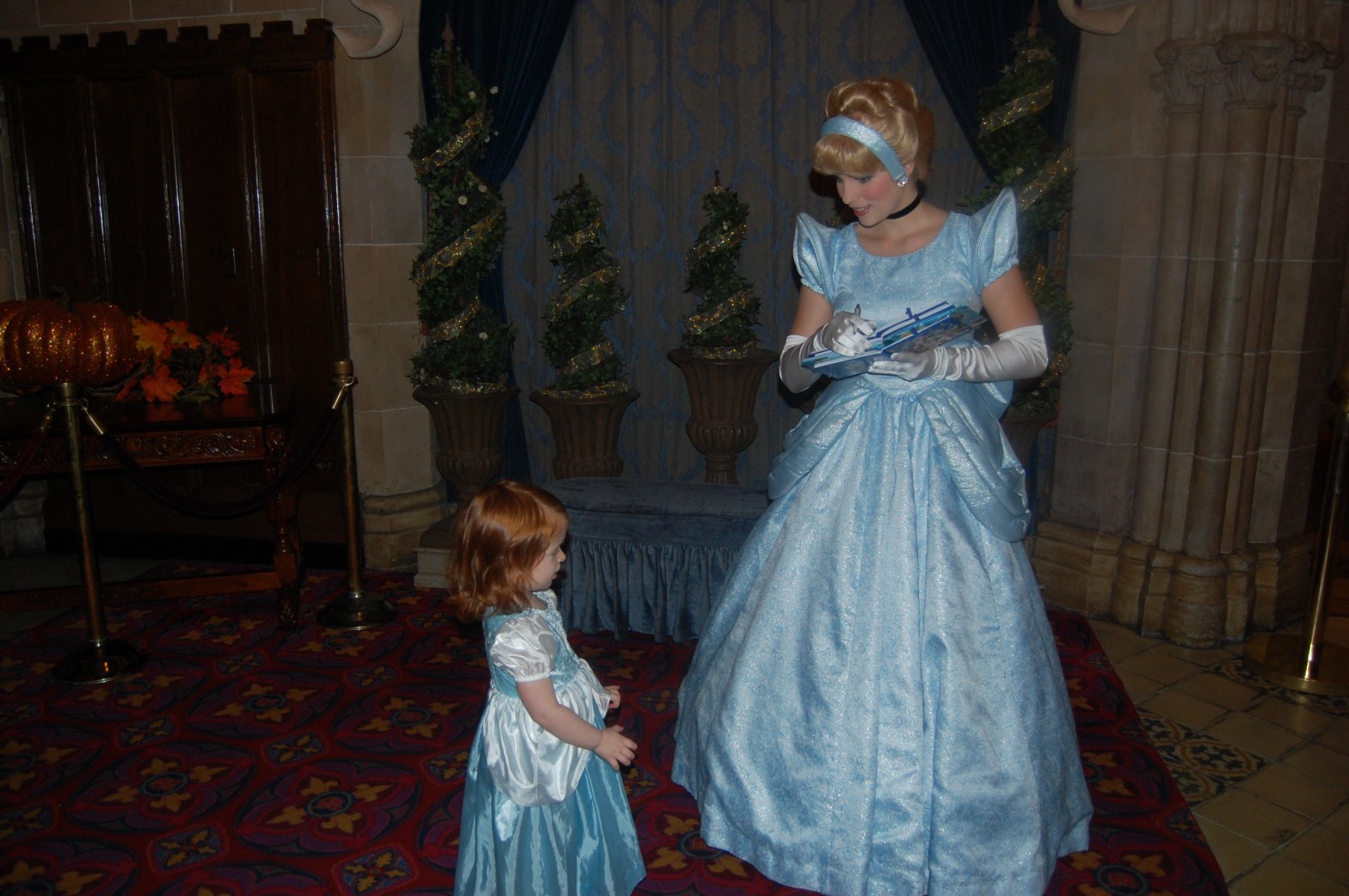
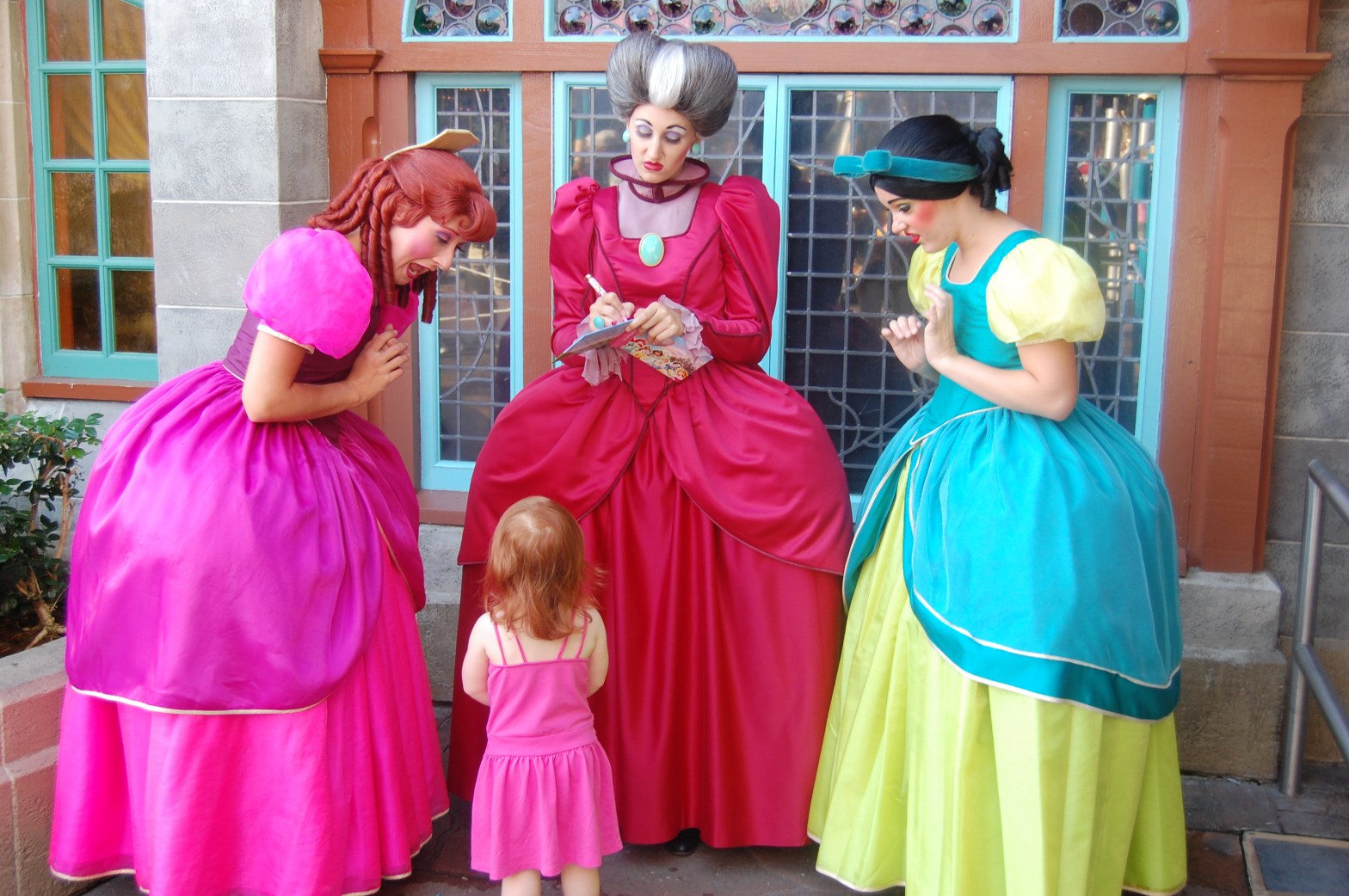
That’s probably some of the Disney Magic that takes away the aggravation – even from the trips that don’t go as planned and leave us with the memories. I’ve been aggravated, for sure, on trips we’ve been on since then, but the formative memories that remain from those trips are the happy moments. Those moments watching my daughter with the evil stepsisters:

Or of my little one sleeping in my arms on the safari. My brothers-in-law hiding in the back at Chef Mickey, wishing they were somewhere that might serve them something stronger than fountain coke to drink if it’s going to be as loud as it was. Of later trips when we discovered the Tutto Gusto Wine Cave (no reservations required, SHHHHHH, they serve a full and delicious lunch menu and are more than happy to bring over pizzas and spaghetti for the kids). Of eating ice cream in the hub and watching the Festival of Fantasy Parade with the castle in the background.

And here’s the thing. Too much reality acceptance can be tough to take. So, even while I want my clients to accept the reality of the situations that they’re in so that they can begin to deal with them. I want them to dream and to romanticize as well. Having things that bring you joy is what makes life worthwhile.

SO even though the sweater doesn’t really comport with reality, I continue to wear it because it fits with my romantic notion of fall and my memories of it from when I was a kid.

Emotion Modeling

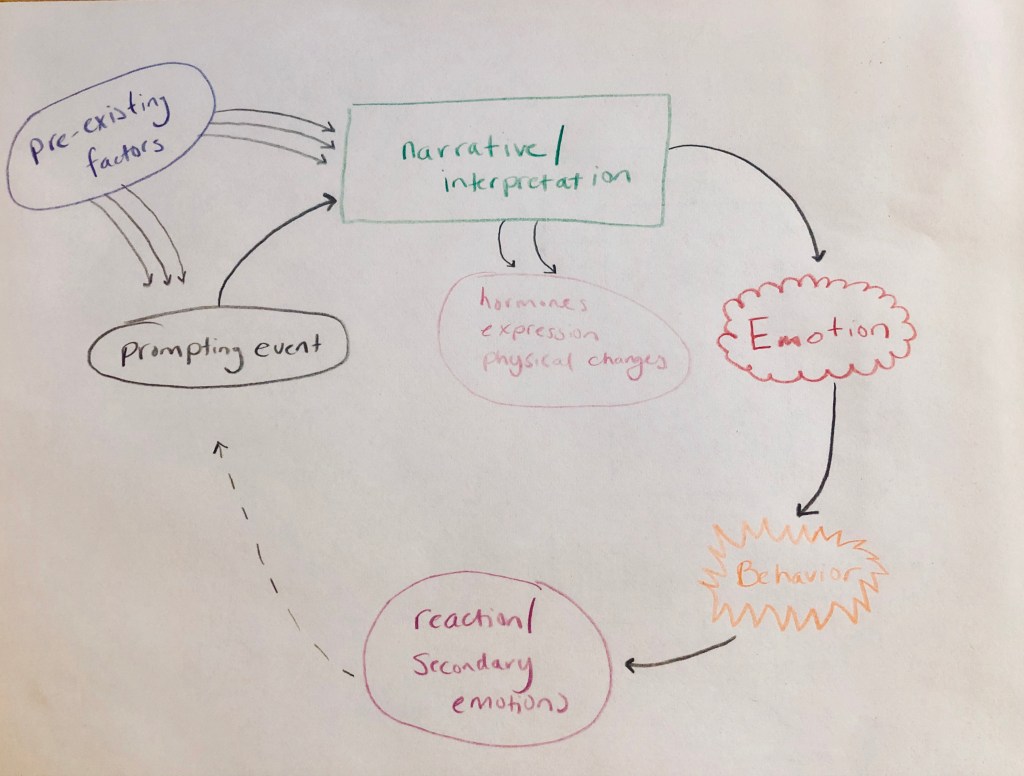
I’ve been working with several of my clients lately to diagram their emotions. I think about emotional reactions as reasonable (in that the client has reasons for reacting the way that they do) and rational (meaning the reaction makes sense if you see things the way the client is seeing them) in most situations. By drawing out the chain of events, it becomes possible to consider ways of breaking that chain at each juncture to change outcomes.

This model, based on the model created by from Marsha Linehan, the psychologist who created Dialectic Behavior Therapy, is so useful for helping clients to see how their emotions are both caused BY and the cause OF their reactions. It’s a simplified version of Handout 5 from her DBT Skills Training Handouts and Worksheets, second edition.

I think we enter the cycle depicted in this model usually at Behaviors. By enter the cycle, I mean become aware that there’s even a cycle happening. Most people can notice that they’ve done something even if they’re entirely unaware of why they’ve done it or even that they were making a choice and responding to emotions when they do it.

I often think about my road rage example – I generally am not totally noticing how angry and stressed I’m feeling until I’ve already cut someone off or blocked someone from improperly merging at the last second in the exit only lane! But there were things happening well before the behavior and the ultimate goal is to break the chain somewhere before behavior to change the outcome of a given situation.

When working with clients, we start with the behavior and work backwards – ok, I was cutting someone off. What was I feeling at that point? Angry, obviously. But under the anger? Disrespected? Overlooked? Anxious about being late? Ok.

Now we go to what was I telling myself that made me feel that way? Probably there was a story about the other driver seeing me and thinking that I’m unimportant. Maybe also a story about how my trip is more valuable than the other driver’s trip? There is usually also a story about how a good mother would be on time.

That last one gets at my pre-existing vulnerabilities – I have a some pre-existing beliefs about myself as a mother and what a good mother would be. Largely based by my reaction to and learning from my own mother (who was generally late, but that’s a story for another time. It boils down to: I had to wait for her to arrive a lot – I was the last one picked up a majority of the time – and it felt bad so I never wanted my kids to feel that way).

So the prompting event? Running late or driving to activities in general! That one was easy.

Finally, I ask how they feel when they realize the behavior – to return to my road rage example – ashamed and embarrassed. Which then makes me irritable and we start a new cycle of reacting to the shame and embarrassment…

Why do I do this with clients? Because in looking at the road rage example, I can change the outcome – shame and embarrassment – by changing any of the steps along the way to that outcome. I can pause before I act on the behavioral urge and choose a different behavior – controlled breathing or distraction are good ones in the car. I can challenge the narrative that the other drivers are disrespecting me (by realizing that they probably aren’t thinking about me at all and seeking other information – how do I know they’re not driving a woman in labor to the hospital and need to get there more than I need to get from piano to soccer?). I can reduce the prompting events by simplifying my kids’ schedules (that one’s HARD!).

The pink box in the middle is helpful if you want to recognize the emotion – I started getting control of my emotions in the car by observing the changes in my body language when I was experiencing the emotions – clenched hands and racing heartbeat – those involuntary physical changes that occur because of my feelings about the narrative I’m spinning in my head about the situation I’m in. Those can be almost as easy to spot as the behavior and can also provide a way to break the chain and a clue to what we’re actually feeling…

OR, and this is where we’re headed in therapy – I can reduce my pre-existing vulnerabilities by trying to be kinder to myself as a mother and more forgiving of my own mother for her lateness by acknowledging that we’re all just doing our best and that a good mother isn’t one who’s always on time if that means they’re a raging monster to get there!

Fiction Friday (the first)

I’ve had some ideas for books – fiction and non-fiction circling in my head. I never actually share them with other people or even really write them down. An idea I had today (or awhile ago, who knows, they always seem to run around and around on a loop and never get pulled out and dealt with) was to start writing a few pages of fiction each Friday to get some practice at writing them down. I tend to go over-wrought on the details and I’m working to strip that out and get down to the ideas themselves but these might be ROUGH. Feel free to give any feedback you like, but I’m hoping to just start writing stories or bits of stories once a week – just to get myself going…

Crisp and burning, a long, grateful draw filled lungs already soaked in the musty, slightly urine-soaked smell of the alley. Brushing at damp strands clinging to her forehead, Maude studied the round face of the girl standing beside her sucking desperately on her own cigarette. Furtive glances around them assured them that no one, particularly not their landlord who was strictly against smoking or smokers in his basement apartment, was watching them huddle in the dark shadow of the alley around the corner from their Adams Morgan apartment.

Slightly too hot in the oversize sweater coat she had thrown on to cover her t-shirt and yoga pants, Maude shifted uncomfortably, edging her toes exposed in worn out flip flops away from the questionable damp patches around the edge of the road. The waistband of the yoga pants, which used to sit attractively on her hips, now cut in to the soft white flesh of her belly, expanded due to too much beer and not enough exercise recently.

Maude shifted again and tried to pull her attention back to whatever Sadie was discussing. Probably something relating to her co-workers and how they were all less capable, less efficient, less motivated, less, less, less than Sadie herself. But who knew, maybe it was something different even though it rarely was. Blink. Blink. Maude sighed and forced herself to reassure and commiserate “I don’t know why you do his work for him, you know the filing rules better than he does, just let him screw it up and maybe they’ll recognize how much you do.”

Sadie worked in a K Street law firm as a paralegal tasked with managing their campaign finance filings. Sadie, to hear her tell it, was the only person capable of understanding the arcane rules of campaign finance and definitely the only one in her office who cared enough to actually follow them. She was probably right, nobody in DC cared much beyond the title they could tack on to their name and the grand idea they could present as their own. Day to day minutiae and details of the actual laws were more academic than interesting – especially in this town where they were written, if not ever actually felt.

Sadie continued to draw strenuously at her cigarette, as if she were in a race against time to finish it, with just short puffs of smoke released in between drags. Maude coughed slightly and reminded herself to return her own cigarette to her lips. Maude started smoking two years ago, mostly as a reason to take study breaks during her first year of law school at Georgetown University. Girls prettier and more fun than she had met on the roof of the law school residence and she’d not wanted to be left out. She smoked now as a way to hang out with Sadie and because of habit rather than any actual desire for nicotine. Maude wasn’t sure what the cigarettes said about her, but then she wasn’t sure what she wanted them to say either and continued to maintain her habit out of, well, habit.

Laughing voices and shuffling steps toward their alley had both girls shifting anxiously and peering out, blinking eyes dulled by the shadows of the alleyway against the light spilling out the doorway on the corner that had opened to gush five people onto the street.

“Hey, you got a light?”

Sadie jumped forward, happy to be approached once she realized that the group of five was men around their age – as if there would be any other guys wandering Adam’s Morgan late on a Saturday night. As the group moved forward to take Sadie’s outstretched lighter, Maude noticed that all of them had the neatly cropped hair and three out of five wore the Hill Staffer’s uniform of khaki pants and button down shirts. They shuffled at the edge of the alley and Maude resisted the urge to scuttle further back into the corner.

Heaving a sigh, she forced herself to step toward the interlopers, rather than away.

“Party kind of sucks, they won’t even let us smoke in the backyard,” one of the staffers was saying, with a shrug. Sadie laughed a bit louder and longer than she normally would have at something a staffer had said. Shifting a glance to at her roommate under the fringe of her hair falling against her cheek Maude resisted the urge to stroke Sadie’s arm in an effort to calm her.

“What are you doing tonight?”

Maude jerked and stopped her contemplation of Sadie’s attempts to captivate two out of five of the interlopers when she realized that one of them had spoken directly to her.

Mechanically raising the cigarette to her lips again, more to buy time than anything else. Maude shrugged. “Raging. Obviously.”

Staffer number 5 (they’d introduced themselves but Maude had missed it in her contemplation of Sadie’s laughter) blinked twice and then smiled, recognizing the dry sarcasm in her response after a minute’s contemplation.

“Obviously,” he muttered, blushing a bit.

Sadie felt her chest expand a bit and curiously, her desire to finish her cigarette diminished enough that she was able to drop it to the group and grind it out with her toe, before smiling at number 5. “I’m studying, actually,” she offered quietly. “Law school.”

“Georgetown or American?”

Number five had a true staffer’s grasp of the important status question to be covered before conversation could proceed.

“Georgetown. Exams are coming up”

Spring exams 2L year at Georgetown University Law Center had the air of being a last gasp before freedom. Most students had a summer job lined up with a law firm and just needed to maintain a slightly better than passing grade point average in order to achieve that coveted offer for post-graduation employment. Being a summer associate meant avoiding alcohol just enough not to embarrass oneself by sending out a stupid firm wide email or dancing on a bar, but not enough to be seen as boring and uninteresting.

Maude wasn’t sure that her summer job in Paris, France would lead to after graduation employment, but then, she wasn’t sure she actually wanted to move to Paris long term – just long enough to get out of DC and away from Sadie. She and Sadie had been feeling cramped and aggravated with each other more often than not lately.

Number 5 nodded sagely, as if he knew all about law school exams. His slightly shaggier than his companions’ hair falling over his forehead endearingly.

“I think we’re going to bail on this in a bit – you want to come hang out somewhere?” his friends stopped at stared, surprised that these alleyway girls were anything other than a five second pause on their way somewhere else.

Sadie jumped in while Maude still wondered what just happened. “Of course! We just need to change and finish up our work.” Maude resisted the urge to point out that Sadie definitely didn’t have work to do, but that she, Maude, definitely did. And that she, Maude, definitely didn’t really want to go out, but she swallowed that thought seeing the embarrassed chagrin in number 5’s eyes when he realized that he’d invited both of them to hang out.

Shrugging, she managed “that would be fun, yeah.” Shifting on feet that wanted to carry her straight back to the comfort of her apartment where she could lock the door and pretend this hadn’t happened. She could see the other four elbowing each other and imagined she could hear their laughing at both her, Sadie and number 5 for this situation.

“Pete, man, they said they were studying..” one tried to avert disaster.

“It’s cool,” Maude forced out, straightening her spine and easing her cardigan open enough to reveal the slightly tighter tank top she wore underneath, hoping desperately that the bulge over her hips where the yoga pants dug into her hips didn’t show. She wasn’t sure what made her want to challenge them, but she felt a driven to make them regret their laughter and, well, regret.

Also, now that she knew number 5’s name, she felt almost interested in him.

Time in the car…

Today was a long day. The kids are back to school and the early morning coupled with the restart of all of their activities means I spend a lot of time in the car.

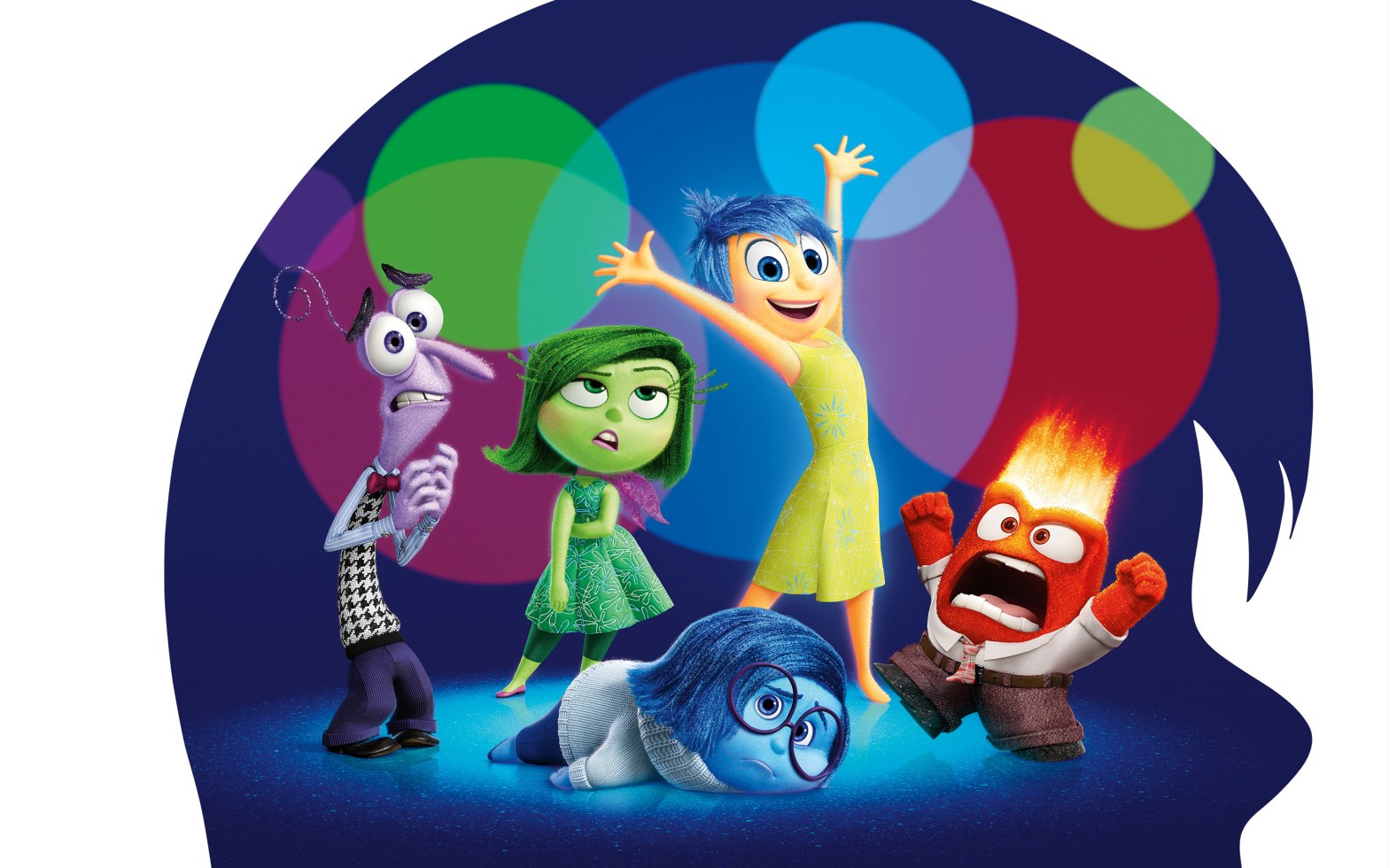
In Houston, for me, the car means aggravation, frustration and a little bit of road rage (maybe more than a little bit, I might resemble Anger from Inside Out more often than I would like).

I realized a few years ago that I was angry and frustrated all of the time and a lot of it was because I was sitting in my car steaming over the driver who cut me off, the driver who drives 15 miles below the speed limit in the left lane, or the construction workers who manage to block off all but one lane of traffic during rush hour. I was in my car desperate to get to the next destination, frazzled, fists tight on the wheel, body tense and leaning forward, mouth turned down.

Fun mommy time for my kids in the car with me.

I realized that while I was probably right: the driver who cut me off was rude, the slowpoke in the left lane was oblivious, and that the construction was inconvenient, I was also missing the point. The point of getting into the car is to get where I’m going. The point of being in the car with my kids (instead of hiring a driver or nanny to haul them around or instead of insisting that they give up the activities altogether) is to spend time with them. To hear about their day. To enjoy their company.

SO, while my frustration was righteous and even felt pretty good at the time. It wasn’t effective at meeting my goals – getting to where we’re going safely and as enjoyably as possible.

I realized that I needed to use some of my hard learned dialectic behavior therapy (DBT) skills to get through the drive.

First, mindfulness. I needed to be aware of my anger before it got to the point that I’m muttering under my breath and driving faster than I should. Surprising as it sounds, I wasn’t always aware that I was annoyed – I mean, I noticed when I was muttering under my breath, but I wasn’t aware of it before then. I wasn’t just frustrated, either. I was ashamed and anxious. Anxious about being late to the next thing we needed to get to. Ashamed of myself as a mother for not being able to get where we were going efficiently and on time. The easiest way to be aware of my emotions, the easiest way for a lot of people, was to observe my body language. My hands gripping the wheel. That’s the first sign.

If I’m keeping a watchful eye on my hands, I can be aware of my emotions before they get overwhelming. I can head them off at the pass. First, I can loosen my hands on the wheel. Often, this just soothes my nerves enough to let go of the frustration. Second, I can remind myself that the other drivers might have reasons for driving the way they do and that I can’t know what those reasons are. Third, I can remind myself that, in the end, my ideas about needing to be on time aren’t really accurate and aren’t actually a measure of who I am as a mother. That I’m doing the best that I can.

Sometimes, though, the best way to avoid the frustration and aggravation is distraction. That’s where Disney comes in. I love a Disney podcast – trip reports, news, Disney Vacation Club information. I listen to them on the drive and they make it easier to sit in traffic because I don’t mind being in the car. I save them now, for when I’m running and when I’m driving. Doesn’t matter if they’re talking about things I already know, they’re entertaining and fun and allow me to dream of the vacations I’ll take in the future.

Distraction from our problems isn’t always a bad way to cope. We can’t live in distraction forever because it turns into avoidance. So, when I’m not in the car, I have to consider my doubts about myself as a mother and challenge my beliefs about what it means to be a good one. But in the car, when we just need to get happily where we’re going, distraction can be an awesome way to go.

Emotions with a point…

I’ve been thinking about mental health a lot lately. We use words like diagnosis and disorder pretty freely in working with clients. We’re trained in school to think in terms of pathology and symptoms. To look for disorder or illness. To search for dysfunction.

In my DBT skills group the other day, we started talking about whether anxiety and depression are illnesses. Some in group felt empowered by calling their diagnosis an illness, because it implies that one can get better or fix the problem. They also find that the word illness lessens the sense that this is something they should just get over or something that they CAN just get over. It takes away the stigma of it being all in the minds.

I agree with all of this, but I feel a personal rejection of the word illness with regards to depression and anxiety. They are parts of personality and an individual’s neurological make up and must be coped with and dealt with, but they aren’t caught and they aren’t necessarily cured in the way that an illness might be. I think of them as more akin to chronic conditions than to illnesses. They are a function of the way that the brain is wired and the environment that someone grew up in, but that is also the case with someone’s accent or even their sports or academic aptitudes.

They’re a predisposition more than they are an illness.

I worry that looking at mental health conditions as illnesses creates a sense that its contagious or catching. We fear the things we don’t understand and reject those things that we worry will contaminate us – that’s the entire purpose of disgust, it helps to steer us away from things that might harm us or make us sick. But that’s the whole thing about our emotions, when they’re rational they’re super useful and not to be avoided – avoidance leads to even greater problems!

Much like in the movie Inside Out, all of our emotions have a genuine purpose to serve and we don’t benefit from wishing them away. Anxiety helps us to care about things. If we weren’t anxious about the test, we wouldn’t study for it. If we weren’t anxious about being accepted, we wouldn’t have reason to follow social norms. Depression can make change how we process information and slow us down to be more detail-oriented and accurate at complex tasks. It’s also a beneficial response to genuinely sad and traumatic circumstances.

Clients come in looking to be fixed and part of how I see my job is in helping them to see that they’re not broken. They’re wonderful and valuable people as they are when they come in.

This is not to say that they are not suffering and that we don’t need to change how they’re coping and thinking to alleviate some of their distress, but it’s also not to say that when they’ve finished with therapy that they will not experience sadness or anxiety again. The reality is that people who have anxiety, will likely always experience some amount of anxiety, but people who have anxiety can learn to cope with it better and to live with it in a way that does not prevent them from true joy and a life that feels worthwhile and fulfilling. People who have experienced a depressive episode are more likely to experience another, but with improved mindfulness, self care and coping strategies they can learn to manage their emotional responses in an effective and useful way.

So much of my job is making people see that they’re not broken, that they’re not sick in the way that people have possibly told them they are, that they’re not WRONG for feeling the way that they do. That they are good and worthy and just need to cope differently given the hand that they were dealt in life.